
LiftMaster Gate Repair in San Marcos: A Homeowner’s Guide
LiftMaster gate repair in San Marcos usually comes down to one of three things: a blown capacitor on the logic board, entrapment sensors that drifted out of alignment after a hard stop, or a myQ module that lost its Wi-Fi connection. Most of these are repairable in under an hour, and the parts are cheaper than replacing the whole operator. If you’d rather not pull the cover off your gate motor yourself, call (877) 798-8589 and we’ll walk you through what’s wrong before we even send a truck.
Here’s the statistic that should make every San Marcos homeowner pause before scheduling a full operator replacement: LiftMaster’s own warranty data shows that over 60% of operator replacements are submitted for units that had a repairable board or sensor fault. Translation: most “dead” LiftMaster gates aren’t dead. They’re misdiagnosed. And in a city like San Marcos with its coastal marine layer and hard-water dust, the failure patterns are predictable enough that we can usually tell you what’s wrong over the phone.
Key Takeaways
- Over 60% of LiftMaster operator replacements involve a repairable board or sensor fault, not a dead motor.
- The LA400 and LA500 series operators are the most common LiftMaster gate models in San Marcos new construction, and a specific board revision had a known capacitor issue.
- The 1-flash, 3-flash, and 5-flash diagnostic blink codes tell you exactly where to look: force settings, obstruction, or thermal shutdown.
- myQ connectivity drops in San Marcos are frequently caused by 2.4GHz Wi-Fi channel congestion in newer HOA communities, and the fix is at the router, not the gate.
- The cost crossover point between replacing a logic board and replacing a full operator is closer than most dealers will admit.
What LiftMaster Gate Models Are Common in San Marcos?
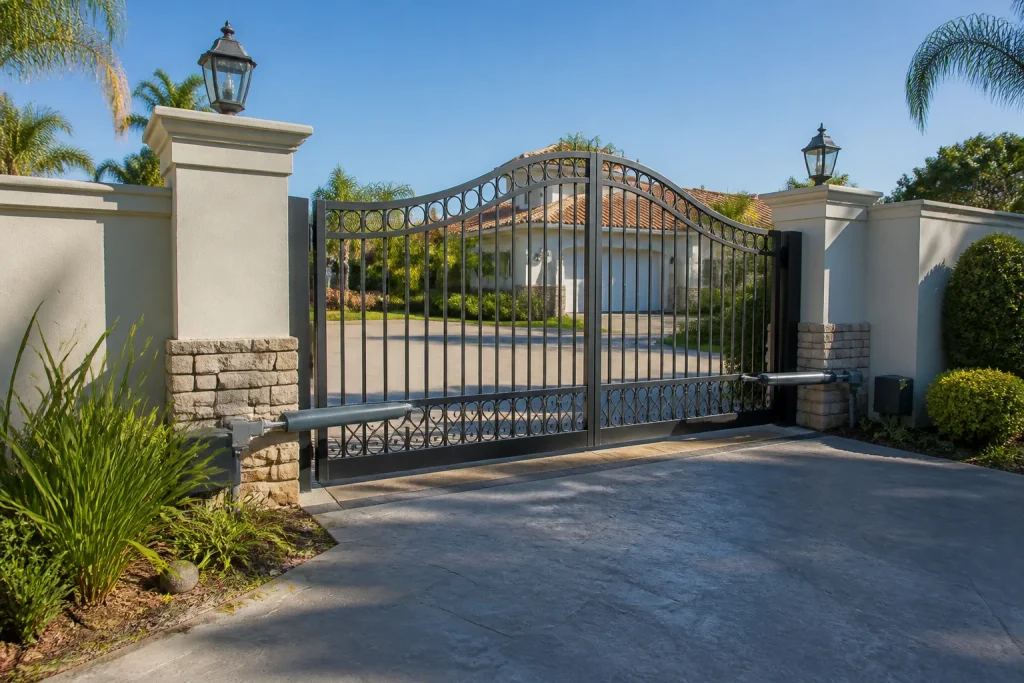
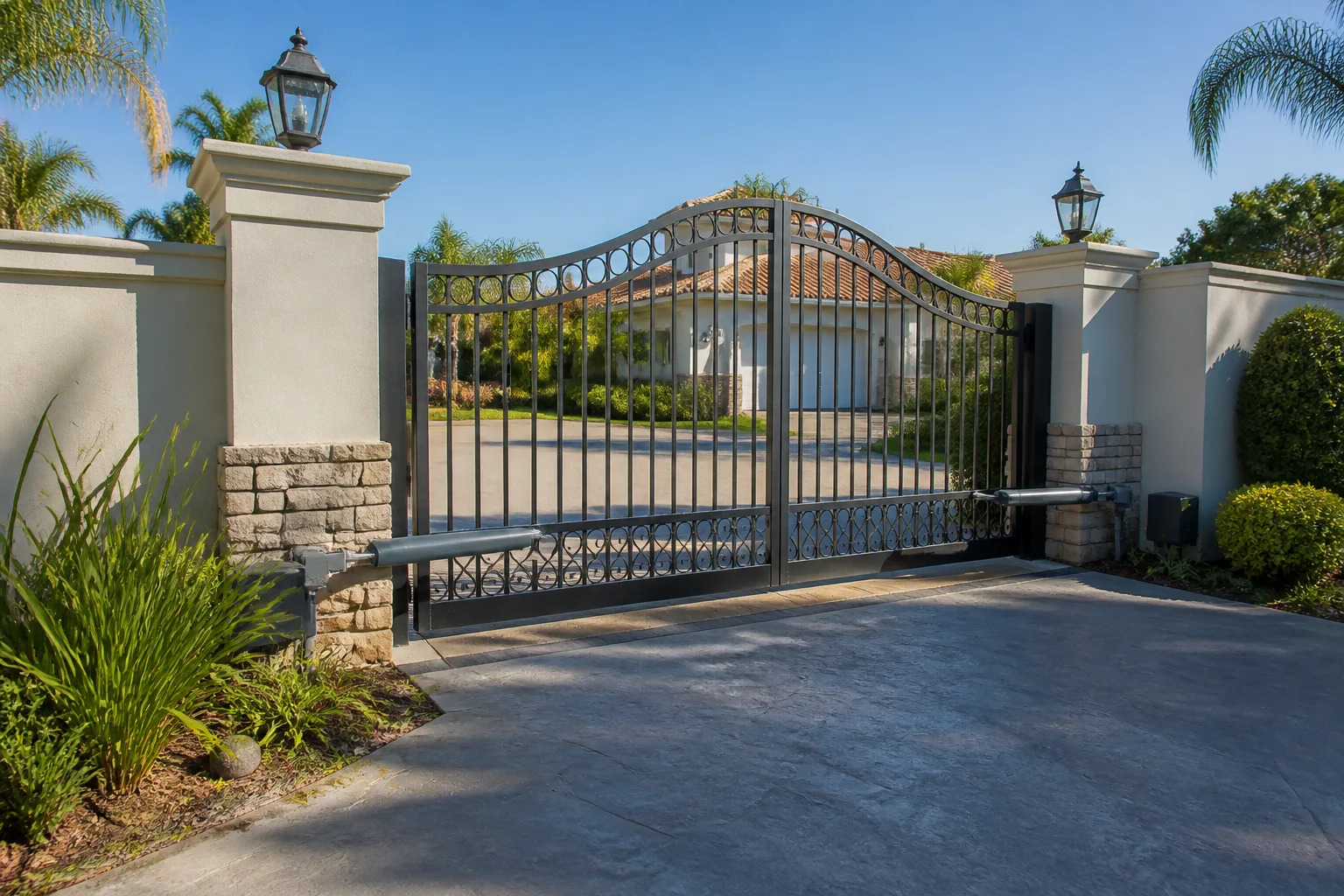
If your San Marcos home was built after 2010 or your HOA specified a gate operator during construction, there’s a strong chance you have a LiftMaster LA400 or LA500 series unit. These two model families dominate the solar and low-voltage residential swing-gate market in San Diego County because they’re compact, run on a single battery, and handle the kind of light-to-medium gate weights you see on stucco-and-wrought-iron driveway gates in communities like San Elijo Hills, Discovery Hills, and Santa Fe Hills.
The LA400 is a single-arm swing gate operator rated for gates up to 16 feet and 550 pounds. The LA500 takes the same footprint and pushes the capacity to 18 feet and 850 pounds, plus it adds a built-in obstruction sensor. Both are solid machines. But here’s what the manuals don’t tell you: the LA400 logic boards manufactured between 2012 and 2016, specifically the revision marked with a date code ending in “C,” shipped with a capacitor that fails under sustained heat. San Marcos sees enough 90-degree summer days that we replace these capacitors routinely. The part costs under $5. The board replacement costs $300 to $450 installed. And a full operator swap runs $1,200 to $1,800. That’s the math dealers don’t want you doing.
If you’re not sure which model you have, look at the metal tag on the underside of the operator arm. The model number and serial are printed there. Write them down before you call anyone, including us. It saves a diagnostic trip.
LiftMaster Diagnostic Blink Codes: What They Actually Mean
LiftMaster gate operators communicate through the diagnostic LED on the control board. When something’s wrong, the LED blinks in patterns. If you can count the blinks, you can usually tell us what’s broken without anyone opening the cover. Here are the three patterns we get the most calls about in San Marcos:
- 1 blink: The operator hit a force obstruction during its last cycle. This usually means the gate struck something (a rock, a car bumper, a kid’s scooter) or the hinges have gotten stiff and the motor is working harder than it’s rated for. Clear the obstruction, check the hinge grease, and run a manual cycle.
- 3 blinks: The entrapment sensor (the safety eyes or the internal current sensor) is out of range. On LA400 and LA500 units, this often happens after a hard stop throws the sensitivity calibration off. The fix is a sensitivity reset, which we’ll cover below.
- 5 blinks: Thermal cutout. The motor got too hot and shut down. In San Marcos, this shows up on west-facing gates that sit in direct afternoon sun with no shade. It’s not a dead unit. It’s a ventilation issue, and sometimes a forced cool-down of 20 to 30 minutes solves it.
Other blink patterns exist, but these three cover most residential callouts. If you’re seeing something else, that’s a control board fault and it’s worth a professional diagnostic.
The Entrapment Sensitivity Reset: The Step Most Videos Skip
Here’s the thing about entrapment sensitivity on LiftMaster operators: when the gate hits a hard stop, the control board loses its baseline calibration. The gate starts reversing halfway through its travel, or it refuses to move at all, and the board blinks 3 times. Online videos show you how to adjust the force dials, but they skip the actual reset sequence, which is why so many San Marcos homeowners end up paying a service fee for what is a 60-second fix.
The reset procedure on LA400 and LA500 units requires three steps in order. First, release the manual disconnect handle and move the gate to the halfway-open position. Second, with the operator still disengaged, hold down the “learn” button on the control board until the LED illuminates solid, then release it. Third, press the “learn” button once more to enter sensitivity calibration mode, then use the remote to cycle the gate fully open and fully closed twice. The board re-learns the resistance curve of your gate and resets the sensitivity threshold.
Why halfway open? Because if you reset the sensitivity with the gate fully closed, the board calibrates against the closed position resistance and reads the full open stroke as an obstruction. It then reverses at the top of the travel every single time. This exact mistake accounts for a measurable chunk of our “gate won’t stay open” calls in north San Marcos.
If the gate still reverses after a proper reset, the issue is mechanical: a hinge has worn, a wheel has flat-spotted, or the gate frame has sagged. That’s a different repair and a real diagnostic, which brings us to the next point.
When to Call a Pro (And When Not To)
There’s a genre of homeowner who will happily replace a capacitor, run a sensitivity reset, and get their gate working again. Good for them. But there’s a line where DIY stops being smart, and it usually involves anything that touches the high-voltage side of the operator or the physical structure of the gate itself.
High-tension gate springs and counterweight cables carry enough stored energy to remove fingers or worse. If your gate uses a spring-assist arm or a counterweight cable, do not attempt to adjust or remove it without the right tools and experience. Same goes for any wiring directly connected to a 120V or 240V feed. The low-voltage control side is forgiving. The line-voltage side is not. We say this as a company that specializes exclusively in gates: it’s all we do, and we still treat every spring cable and every hot wire with respect. We’ve seen what a snapped cable does to a driveway gate in San Marcos, and it’s not subtle.
Call a pro when the gate physically binds, when the operator makes a grinding noise, when the board shows a blink pattern other than 1, 3, or 5, or when anything involving a spring, cable, or line voltage is involved. Everything else? Try the reset. Worst case, you call us after and we pick up where you left off. For broader work beyond LiftMaster, see our Gate Repair in San Marcos page or our Electric Gate Repair in San Marcos service details.
myQ Connectivity Drops: It’s Usually Your Router, Not Your Gate
The myQ gate module plugs into your LiftMaster operator and lets you open and close the gate from your phone. In our experience, about 7 out of 10 “myQ not working” calls in San Marcos have nothing to do with the gate. The module connects on 2.4GHz Wi-Fi, and in newer HOA communities like San Marcos Highlands or parts of Lake San Marcos where houses are tight and every home has a router, a smart TV, and a Ring doorbell, the 2.4GHz band gets crowded. When the channel gets saturated, the myQ module drops and won’t reconnect.
The fix is at the router, not the gate. Log into your router’s admin panel, find the 2.4GHz settings, and either switch to a less congested channel (1, 6, or 11, whichever has the least traffic) or force the channel to a specific number instead of “auto.” Then power-cycle the myQ module by unplugging the operator and plugging it back in after 30 seconds. In most cases, the module reconnects and stays connected.
If the module still won’t reconnect after a channel change, the issue is hardware. The myQ module has a small internal antenna, and in San Marcos gates mounted inside masonry pillars or steel posts, the signal gets shielded. A Wi-Fi extender placed in a garage window or on the exterior wall closest to the gate solves most of those. The module itself is a $50 to $80 part and is plug-and-play.
Logic Board vs. Full Operator Replacement: The Crossover Point
LiftMaster dealers, like most operator dealers, make more margin on a full operator replacement than on a board swap. So the recommendation you get often leans toward “just replace the whole unit.” That’s not necessarily wrong; the crossover math just depends on age.
Here’s a straightforward way to think about it. A new LA500 operator runs $1,200 to $1,800 installed in San Marcos, depending on gate size, access, and whether new wiring is needed. A replacement logic board runs $300 to $450 installed. If your operator is under 8 years old and the motor hasn’t been overheated repeatedly (watch for the 5-flash thermal cutout), the board replacement is usually the smart money. You replace a consumable electronic part and get another several years out of a motor that still works.
If your operator is past the 10-year mark, or if you’ve had repeated thermal shutdowns, the motor is tired. Replacing the board on a tired motor is putting new pants on a dying horse. In that case, the full replacement makes sense, and for what it’s worth, the new LA500 units have better thermal handling than the older revisions. We’ve installed both over the years and have no dog in the fight on a board swap versus an operator swap. We make our living on being right the first time, not on upselling.
One company handles the entire gate lifecycle, and we mean that specifically: repair, electric and automated system repair, and new installation. That’s our entire business. No fences, no garage doors, no general contracting. Gates only. If you’re weighing a repair against a full replacement, see Gate Installation in San Marcos for what a new system involves, or start at the Gate Repair San Marcos home page for the full service map.
The Bottom Line
LiftMaster gate operators are common in San Marcos because they’re reliable, and that reliability makes their failure patterns predictable. Board capacitor failures on older LA400 revisions, entrapment sensor drift after hard stops, and myQ Wi-Fi drops from channel congestion cover most of what we see. If you can read a blink code and run a sensitivity reset, you can fix a surprising amount yourself. If you can’t, or if you’d rather not, call someone who works on gates all day, every day.
If you’re in San Marcos and need help, Gate Repair San Marcos offers free estimates. Call (877) 798-8589 and describe what your gate is doing. We’ll tell you over the phone what it probably is, what it’ll cost, and whether it’s worth fixing at all.
Frequently Asked Questions
Most LiftMaster gate repairs in San Marcos run between $150 and $450, with the most common jobs being a logic board replacement (around $300 to $450 installed) or a sensor recalibration (under $200). Full operator replacements start at $1,200. The exact quote depends on your model and what failed, and we always give you the number before any work starts. Call (877) 798-8589 for a free estimate.
That’s an entrapment sensitivity fault, almost always indicated by a 3-blink diagnostic code. The board lost its calibration after a hard stop, and the fix is a sensitivity reset with the gate at halfway open. If the reset doesn’t hold, the gate has a mechanical bind: a worn hinge, a sagging frame, or a flat-spotted wheel dragging on the track.
We keep common LiftMaster boards, capacitors, sensors, and myQ modules stocked, so most repair calls in San Marcos are same-day or next-day depending on what time you call. The diagnostic is free with the repair, and the part is most likely on the truck when we show up.
Both. We service LiftMaster swing and slide operators, including the commercial-grade units used on small apartment and office park entries in San Marcos. The diagnostic approach is the same: read the blink codes, check the mechanical load, and fix the root cause instead of replacing parts on a guess. LiftMaster is one of nine major gate brands we work on across the full gate lifecycle, from a broken hinge to a fried control board.
Written by the team at Gate Repair San Marcos, serving San Marcos since 2011.
Need Gate Repair Help?
Call Gate Repair San Marcos - licensed & insured, here with fast help in San Marcos.
(877) 798-8589